
Flat Circle Converter
Why your crochet circle turns into a hexagon, and how to rewrite the increase rounds so it doesn't.
Why a hexagon?
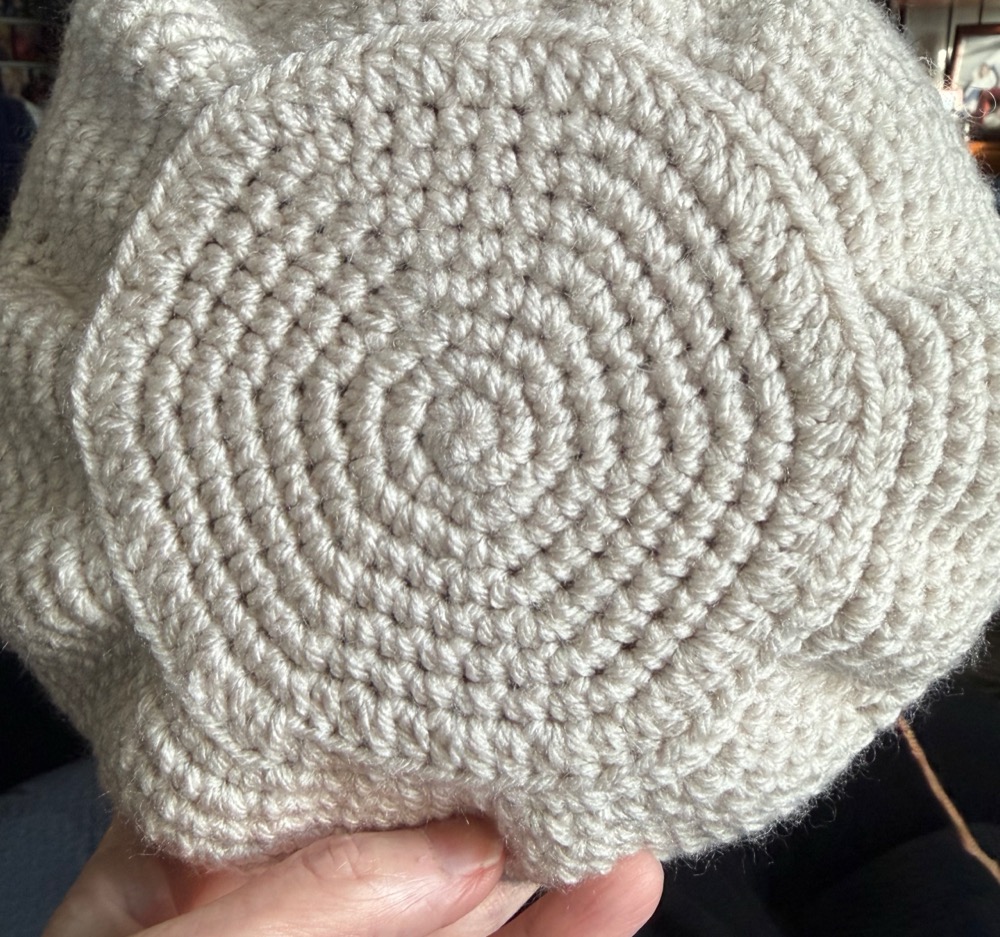
Most amigurumi patterns build a flat circle like this: start with 6 stitches in a magic ring, then add 6 stitches every round.
Rnd 2: 6 inc (12)
Rnd 3: (1 sc, inc) × 6 (18)
Rnd 4: (2 sc, inc) × 6 (24)
Rnd 5: (3 sc, inc) × 6 (30)
Look at where the increases fall. Every round starts at the same place and has the same 6 increases, so each one sits right on top of the one below it. Stack them up and you get six straight "seams" running out from the center. Those seams are the six corners of a hexagon.
A pattern written this way isn't wrong, and the stitch counts are fine. The designer may well have moved her increases around as she worked without writing it down. If you follow it exactly as written, though, the corners line up. Stiff yarns like mercerized cotton make it worse, because they won't relax into a round shape the way a soft acrylic can.
The fix is to keep every stitch count exactly the same and only move where the increases go. Each round, shift them so they land between the increases of the round before.
Rewrite your rounds
Find the flat circle part of your pattern. Enter what the rounds add up to and the tool writes out a round-by-round version with staggered increases.
Your staggered rounds
Use your marker at the start of each round as usual. In a spiral you simply keep going; the first stitches of one round continue from the last stitches of the one before.
Where the increases fall
Each ring is one round and each dot is an increase.
Tips
- Check your first rounds against the original. The stitch count after every round is unchanged, so if yours matches the pattern's numbers in parentheses, you're on track.
- Don't trace a hexagon. If your pattern has you trace the base onto cardboard, trace a staggered circle or cut the cardboard round, not a hexagon.
- Rounds that stack on purpose. A few designs use stacked increases for a flat-sided shape such as a hexagon or a square. For those, keep the pattern as written.
- Only the flat part. This tool is for the flat circle. It doesn't rewrite the sides, spheres or decreases.
- Swatch, then stuff. A tighter hook or a firmer yarn also helps. If your base is still a little bumpy, see how it looks once it's stuffed before you decide to frog.